How fast does the escalator move compared to motion in experiments #1 and #2? Is it faster to walk, take a speed ramp, or take the escalator?
The real objective in this experiment once we recorded the times it took to get on the escalator to the time at the top of the escalator, was to determine the rate of speed the escalator goes and the to determine the length of the escalator on the moving side which for all purposes in this experiment we will call side c of the escalator.
To determine the length of side c we measured the lengths of side a and side b of the escalator. a being the height and b being the width of the escalator. As we measured our results came to be that side a is 208 inches and side b is 363inches as shown in the diagram below. So to determine the length of side c of the escalator we used the equation for a triangle since the escalator in all respects is a triangle. This is where these experiments for this class help me to realize and appreciate math for practical everyday purposes and see more reasoning for formulas and I begin to understand the formulas and what they mean when applying them to projects like these. So back to the formula of a triangle which is called the Pythagorean Theorem and the formula is:
So when we plug in our numbers to the Pythagorean Theorem we find the length of side c² and we take the square root of c². So the problem looks like this:
(208 in)² + (363in)² = c².
Which when worked out is: 43264 + 131769 = 175033. So side c is the square root of 175033 which is 418.37 in.
So our next objective is to find the rate of the escalator which we can now do since we know the times and the length of all three sides. The average time for students to take the escalator to the next floor was 22.54 sec.
So using this data in our d = r t formula we get an equation that looks like this:
418.37 in = r (22.54 sec).
Since we are solving for rate our equation now looks like this r = d/t which is:
r = 418.37 in/22.54 sec = 18.56 in/sec.
So in conclusion, after seeing the results from the first three experiments it is obvious that walking at your own pace is the fastest means of all these three means. The other two, the speed ramp and the escalator are designed more for convince all though when you combine your walking rate with either the speed ramp or the escalator you will be faster than walking alone!
See isn't that fun?!
Attached to this Web page is a diagram of the Escalator At Plaza Frontanac. Use this with the idea that A, B, and C. stand for the "sides" of a triangle.
This experiment is just one of many where you can see how math is integrated into our everyday lives, even in activities such as common as shopping! I really consider math is fun! ft.
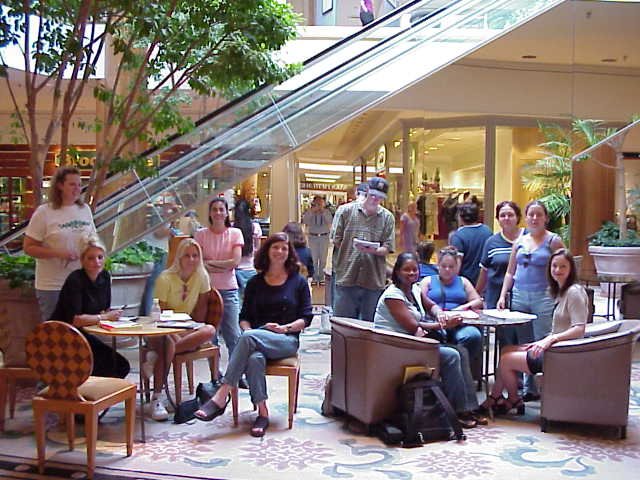
Here are some pictures of our class. For more information and ideas about this project you may link to a page written by one of the following math artists: Danielle's Second and Fourth Web Page, Darlene, Kellie, Jill, Nanyal, Kevin, Crystal, Rachel, Christina, Jennifer, Candice, Vincent, Esther and Melinda. Most of us are in this picture but not in order of names.